Lets Create: Urban Jungle Characters

For the first of the Let’s Create series, I will be looking at a system I kickstarted a few years back; Urban Jungle.

Urban Jungle is described as an Anthropomorphic Noir Role-Play system. It is, as it basically says, a system in which you play a humanoid animal in the 1920s and 30s, between the wars, the period of prohibition and speak-easies, of gangsters and corrupt politicians, of hard-boiled detectives and femme fatales and all that jazz.

There are also two expansions for it – Occult Horror (think Lovecraft or Carnivale) and Astounding Science (think B-grade 1950s pulp sci-fi). I don’t have either yet but do plan to, though I was meant to get the Occult Horror one asa part of the kickstarter. For some reason it didn’t happen.

Before we get around to making characters, I am going to do a basic run through of the system and character creation.

To succeed at a task you generally need to roll a 4 or higher on a dice. The more times you succeed, the better. For more difficult tasks you might need more than 1 success. On the flip side, rolling all 1s means something bad happens to you. So the more dice you are able to roll, the better it is for you on both accounts.

With that in mind, how do you get dice? That is part of the character building process.

Everyone starts with seven traits. There are four basic traits that everyone has – body, speed, mind and will. These are common to all characters, and are pretty much what they sound like. Body represents your physical side, speed your quickness and co-ordination, mind your intelligence and perception and will your personality and willpower.

Then there are three unique traits – species, type and career. These differ for each character but serve the same purpose. Each of these unique traits gives you some three skills and two gifts. Skills are what allow you do accomplish stuff and yes, some unique traits can give you bonuses to the same skills. Gifts are unique talents that your character has, some of which are always active while others give you bonuses in specific situations.

Species represents what type of animal you are – are you a horse, an elephant, a weasel or a porcupine.

Type is what kind of noir person you are – you could be hard-boiled type, a rebel, have a heart-of-gold, be crooked or just be plain old.

Career is obviously what you do for a job – you could be a prize-fighter, a bootlegger, a detective, actor and more.

Once you have picked your species, type and career (say a Sparrow Drifter Biker), you assign your dice to your seven traits. Two are your good traits which get D8s, one is a bad trait which gets a D4 and the rest get D6s. Which traits you assign them are up to you – at D8 in species you maybe the foxiest fox that ever foxed, but a D4 in it might mean you don’t conform to the expected standards and tropes of a fox.

For your three unique traits (species, type and career) find your three corresponding skills and assign the dice value you gave to the trait to it. For example, a coyote gets the athletics, fighting and observation skills. If you assigned D6 to coyote, each of those skills gains a +D6 to skill roles.

List your gifts and gear you get from your unique traits and make note of what bonuses you get from the various gifts.

Lastly, work out your personality. Are you bold, lazy, sad, sneaky or something else? If you undertake an action where your personality is at play, you get a bonus +D12.

And that is pretty much it for how you make a character.

When you come to make a skill check, you get the dice value from your appropriate basic trait plus any dice from skills you may know and any bonuses from other sources, like gifts. Basic traits are not necessarily set for a given skill – they can vary depending on how you are undertaking the action. For example, the deceit skill. If you are just trying to out and out bluff someone, the Will trait would be used. Trying to be light-fingered and nick something without anyone noticing would use the Speed trait. Undertaking a clever deception would use the Mind trait. I really like this approach, where skills aren’t set in stone as to what trait they use. Often it can lead to the ‘one stat to rule them all‘ problem. (Warning, TVTropes link.) I especially like this when it is applied to combat.

With a brief look at the system done, next time we will show off a few character builds and what they can do.

Lets Create…

I have been playing RPGs for over 30 years now, and during that time I have collected a lot of different systems, some of which I haven’t even played. They have just been sitting there collecting dust. Others I have played a lot, mostly Cyberpunk 2020 and various editions of D&D, of which 2nd Edition is the best, obviously.

I enjoy studying the mechanics of the systems, to steal ideas for various homebrews that I have come up with, as well as just making characters. I prefer to make interesting characters, rather than over-optimised ones.

That isn’t to say that I can’t make highly optimised characters. I have, on occasion, done that. But I prefer interesting, unusual and even unique characters. A lot of my characters take cooking as a skill, if it is available. Partially that is because I enjoy cooking, but also it can be a fun thing to play around with in game, even if it serves no real purpose or gives no real benefits. It is something that just makes the characters come to life more.

I had one character, a half-orc barbarian/druid, who collected ingredients from various defeated monsters and cooked them up for the party. It was a change of pace from iron rations, having things like shrieker mushroom and dragon steak stew.

So I plan on starting up a new segment here, specifically looking at looking at these various systems, some well known, others more obscure, and creating examples from them. Not just characters, for some have other things you can create, like the Worldbuilding Guide I have previous started looking at.

I have a half dozen systems already in mind to start with, and more will follow that. So stay tuned as we start an at times wild ride.

Let’s Build a World: Part Nine: Planetology

In our return to the world building through AD&D 2e’s World Builders Guidebook, we are going back to the beginning, to the Worlds and Planetology.

Specifically, we are going to look at what the world itself looks like. From our early cosmology section, we rolled up a terrestrial water world that appears to be our campaign world.  But as we go through the next stage that may or may not be the case.

The first part of the chapter deals with the shape and size of the world and the first table deals with the sizes.  Is it a regular planet shape or something else?  A disc, a polyhedron or something even more bizarre.

On a D100 we roll 26 – a sphere.  So basically a normal looking planet.

Next comes the size of the world – anything from 800 to 16,000 miles in diameter.  Earth is about 8,000 miles for comparison.

On a D100 we roll 25 – 4,000 mile diameter.  In effect our world is only about half the size of Earth, or around the size of Mars.

After that comes hydrography – how wet the world is.  We know that the setting is archipelagic in nature so rather than rolling I select 80% water.  This gives us only around 20% of the world as land, which is still a lot of land as it comes out to maybe a third of Earth’s land surface.

Table 5 in the book deals with the starting of the mapping stage of the world, giving an outline of how much land and water each section of it has when mapping out on a 20 section polyhedral map. Even though I aren’t going to use a polyhedral map, it does give some decent indications.  At 8-% water, 8 sections are water, 6 sections are water with a few minor islands, 4 are water with major islands (around 25% of the section) and 2 are water and land sections, with about half and half of each.

We have an idea of how much land and water there are, but what do they actually look like?  The book moves on then to the continents, islands and coastlines part of the chapter.

If you have a water dominated world, you roll to see the number and size of continents you have and vice versa if it is land dominated.

For our world, we have only 2 regions that are at least 50% land so we have 1d2 continents of 1-2 regions in size according to table 6.  If we were at only 60% hydrography, that would give us 9 regions made up of 1d6 continents of 1-8 regions in size.

The roll gives us 2 continents which means that each will be of 1 region in size.  The other regions with islands in them will be scattered around.

Now to placing them.  If you are using the polyhedral map you just use a D20 and roll to locate where the continents or seas are to go.

The first roll is a 7, which is in the centre of the middle latitudes while the second is a 4, placing it up in the northern reaches.

Next time we will start doing some maps of the regions, basic ones, and work out other matters of planetology, such as tectonics, mountains and climates.

World Building One Off

As you read through the World Builder’s Guidebook, you follow the process of creating a world from the start, from the initial design of the world all the way through to the creation of a single kingdom.

There is also a single one off example of a design of a single location at the cities and provinces level, an area of 40 or so miles, which in the case of the example was a tropical island ruled over by renaissance level elven pirates.

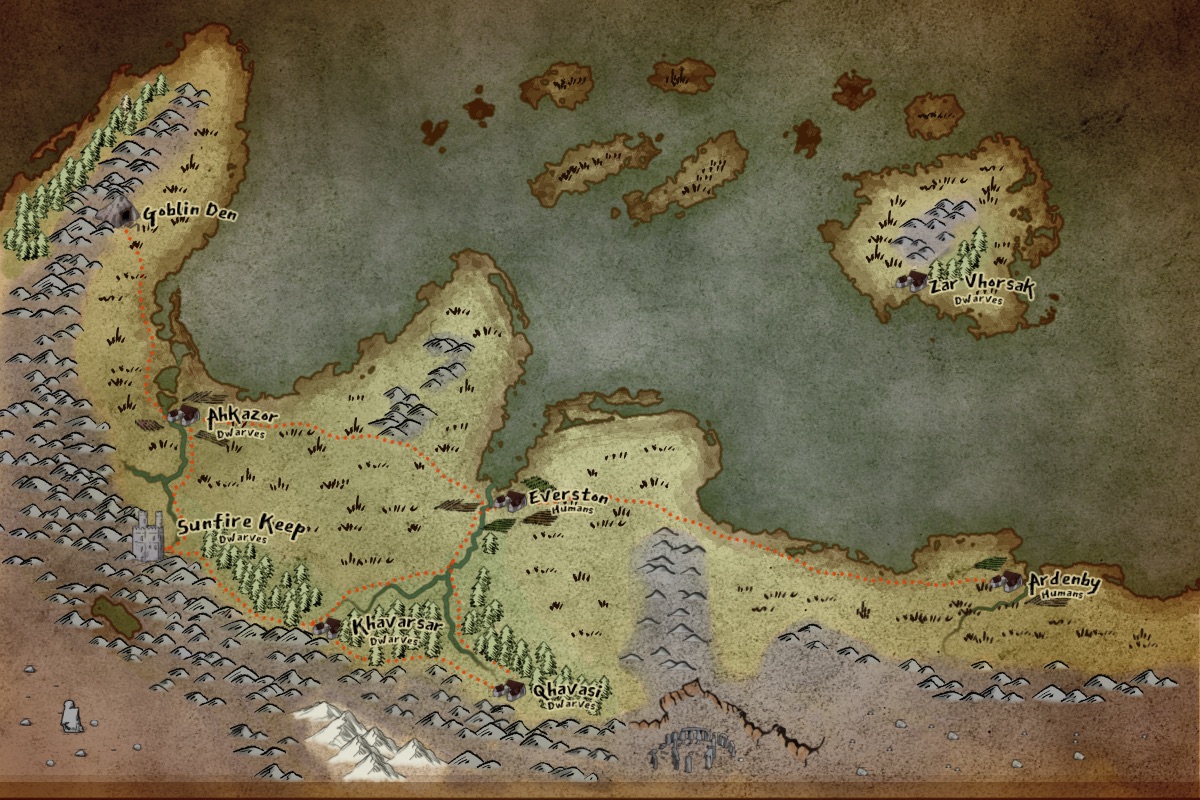
So as an example of building from the bottom up, rather than the top down, I am going to do a one off, of a small region with a handful of settlements and some places for adventurers starting out to explore.

Starting off, I roll on the World Hooks chart, coming up with subterranean initially.  While I do want some subterranean elements involved, I also want a more regular above ground region as well, so I roll again, this time getting arctic.  This also covers sub-arctic, which strikes me as the preferred option.  Those that live there will rely heavily on herding, hunting and fishing to live and the region will have summers with long days and winters with very long nights.

Moving on to see what the region looks like, I roll up coastal or peninsular for the seas and rivers in the region, gentle hills for mountains and hills, moderate for seasonal variation, meaning much as Earth experiences and for humidity, I went with arid rather than humid.

The next step was to work out the predominant terrain of the region – the dice came up with rocky desert, a region marked by boulder fields, stony wastes and weathered bedrock, no doubt wind swept and cold, and probably forming where the hills are.  There will also be regions of the other types of terrain found in the area, such as light forests of needleleaf evergreens and grasslands in the form of dry steppes.  These would be where the inhabitants mostly live.

As to who lives there, a roll on the dominant race comes up dwarves, and there are also three other races, those being goblins, aarakocra and humans.  For each I roll to see how they relate to the dominate dwarves.  The goblins life separately, the aarakocra are completely intermixed with the dwarves, living alongside them as equals, and the humans live separately but are considered equals to the dwarves as well.  The goblins aren’t considered equal for whatever reasons.

Continuing on, a roll on the Cultural Archetypes table comes up with Dark Ages Europe.  This is a time of tribal warchiefs and their warbands, prior to feudalism and the landed nobility.

Rather than rolling on the tech level, I just select dark ages technology.  Don’t expect plate armour to show up here.

The government of the region turns out to be neutral-good theocracy, which is interesting.  In effect the region is ruled over by priest-kings.  Given that religion is obviously an important element here, I roll up the primary deity worshiped, and come up with fire and sun for their domains.  Given the cold of the region and the long winter nights, that fits in well, as the priests provide light and warmth and comfort during that time.

Lastly we roll on subsistence levels, to see how people live in the region.  The result is predominantly by herding/grazing, keeping their herds upon the steppes.  There will also by some light levels of farming, hunting, fishing and mining as well.

Working out the population density, we have a base level of 2 for grazing, +1 for the hills and -1 for dark ages, giving us a level of 2, or low density.  That gives us a town and around 5-10 villages in the region, with a population of around 5000 people or so.

With all of that worked out, I made a map of the region.

Subartic 2 copy

(The map was made with a program called Wonderdraft)

Sunfire Keep is the main settlement, and home of the local Priest-King, with four other villages were the dwarves and aarakocra live, and two of humans, on the coast, each with a local headman.  The goblins have a den up north, leading into the subterranean regions.

This is just the local starting area and later on you can expand outwards.  There would be other small nations of the same culture out there of similar size ruled over by other Priest-Kings, as well as other nations and cultures and races as well.  There are other aspects you could expand upon, such as the nature of the religion, the presence of the goblins and what else dwells in the subterranean regions.

But for now we leave the example here and return to the ongoing world building project.

Let’s Build a World: Part Eight: History

As previously promised, we are finally going to cover the history of the region, with a view to working on the background and trying to make some sense of it.

For that we are going to roll up a campaign timeline that sketches out the history of a region/kingdom/culture.

It is nothing more than a rough lists of dates and major events, and is divided into three sections; ancient history, middle history and recent history.

The events for each section are a little different; recent history has events that people can recall, occurring in the lifetime of many people, even characters, while the events of ancient times are hay and il-remembered, coming down through the ages as myths and legends.

For each we roll to see how many events happened and how many years apart.  Ancient ages have 2d6 events set d6+4 x 100 years apart, middle history is 4d4 events set d6+4 x 10 years apart and recent history has 2d6 events set 1d6 years apart.

So time to roll and see what we get.

Ancient History

0: Technological Discovery – (An important breakthrough in physical/magical technology took place, perhaps the invention of a new school of magic, the development of the printing press, or the introduction of a new weapon of warfare.)

700: Magical Discovery  – (As above.)

1200: Expansion/Exploration – (An ancient people expanded into neighbouring territory or conducted exploration of nearby lands.)

2200: Migration – (An ancient race or culture passed through, settled or departed the kingdom in question.)

2900: Empire Falls – (An ancient empire rose or fell.)

3800: Epic War – (Epic wars refer to great conflicts of ancient history, in which, (for example) all dwarves and orcs struggle for decades or centuries, or the gods themselves take an active hand.)

Middle History

3860: War, Conquest

3940: Intrigue/Scandal – (Some kind of far-flung conspiracy or shocking behaviour rattled the leaders of the area.)

4020: Plague – (Disease swept the region, decimating the population.)

4090: Revolution – (A revolution seeks to overturn the entire social order and replace it with another one.  For example, the serfs or peasantry might rise in an attempt to drag down the nobility and make their kingdom a democracy)

4180: Magical Discovery

4240: Legendary Character – (A particularly famous or noteworthy person lived during this time.)

4290: Invasion/Raids – (The kingdom in question was invaded at some point, and possibly conquered.  The people may have eventually integrated their conquerors, or fought back and threw them out.)

Recent History

4293: Intrigue/Scandal

4296: Natural Disaster/Plague – (A storm, flood, fire or similar local disaster struck the area in question.)

4299: Internal War – (A civil war, failed revolution or war of succession is an internal war, fought primarily between parties or regions within the same nation.)

4304: Raids/Brigandage – (The kingdom was looted and pillaged frequently during the period by foreign raiders or by large and well-organised bands of outlaws.)

All right, lets have a look at some of this.  I’m not planning on working out all the details of what all of it means just yet, but more the basics, and later on I can go back and fill in details.

The ancient period seems fairly easy – breakthroughs both magical and mundane – probably related to build building and navigation and the harnessing of the magic of the seas – saw people spread out through the archipelagos, settlings new lands and forming a grand empire.

But it fell and turmoil followed in the aftermath of that, culminating in an epic war that saw the gods involved, with the Storm Lord and his daughter at the centre of it.

The turmoil continued on into the middle period,  with wars and revolution following, marred by a great plague the ravished the land.

And while this wad going on, someone discovered the secrets of the magic of the Darkness, unleashing necromancy and dark magic on the world.

In 4240, a legendary female warrior arose, sickened by the conflicts that plagued the land.  She in time grew to be the demi-goddess previously created in the pantheon section.

That was only 64 years prior to current events, and despite her efforts, the recent period has been marred by more conflict, with raiders loyal to the Storm Lord and his daughter threatening to once more destabilise the whole region and plunge it into a war in which the gods are drawn into.

And with that we finish up with the history and mythology section of the book.  It does go on a little bit more discussing things like races and classes and kits, magic and monsters, but it is more hints of what you can do rather than rules, and we haven’t reached the stage of world creation to think about that kind of thing yet.

So next time we go back to one of the earlier chapters and start looking at what the world may or may not look like, and the type of people and nations that inhabit it.

Let’s Build a World: Part Seven: Creation Myths

I was planning on moving on to the history part of the chapter next, but instead I came up with some ideas for creation myths.  Two of them actually, taken from either side of the cosmological clash.

Both sides see matters differently and both may have some actual points.  Which one is actually true?  Maybe neither, maybe both, at lest for a given value of true.

Note: these are rough first drafts.

The Pantheon’s Creation Myth

There was, at the first, the Ocean, and it lay still and silent beneath the cold light of the stars.  No winds marred it surface and no life dwelt in its depths.  And the Ocean was the Mother and her spirit passed through it.

For an age she existed with it until she looked up at the stars in the dark of night, and she perceived with in them the ghost of what could be, of a yearning to be and to live, an echo of life that had yet to achieve potential.

And the greatest of these she gathered to herself, forming it into a son, and she gave birth to him, and he emerged fully formed and grown.  Now as he didi, from the depths of the Ocean was likewise born in fire and turmoil an island, the first island, the first land.

And there upon the shores of it, beneath the glow of the fires of the Earth, did the Lord of Volcanoes take up his mantle and his dominion.

And there did he and his mother look up and they saw a darkness pass across the stars and they were troubled, for they knew not what it was, and it was some time before they recognised the emotions that bled from it, of a hate and anger so intense they could have burned the new formed land to cinders if it were possible.

Then did Father Earth ascend to the summit of the island, and he caused the volcano to erupt forth and it sent forth fire into the air, to land in the waters around, and as each surge of fire landed, it became land, and new islands were formed until the waters were filled with them.

But as yet they were empty and lifeless, so once more did Mother Ocean look to the stars, and she brought forth four more and gave birth to them, and these were the Sky Lord, the Sun Lord, the Lady of Life and the Lady of Love and Waters, and to each she assigned a place and bid them work together to shape the world and bring forth others to live in it and enjoy it.

Then did she rest, and she turned her thoughts towards the Darkness, for now it roiled across the heavens and sought to undo what had newly been made.

The Darkness’ Creation Myth

In the Time Before, there was only perfection.  The stars in the silent dark above, the ocean below, all was still and as it should be.  Fear and anger, hunger and pain and misery and emotions did not exist, and would not have, but for the actions of one.  The frozen, unchanging stillness did not allow for such things.

Thus would all have remained, if not for the one who dwelt in the oceans.  Envious, and desirous of domination, she gazed above, to where the spirits dwelt in frozen perfection, and these she began to wrench from their place, binding them to herself, imprisoning them in bodies and subjecting them to the frailties of chaos.  And through them she brought into existence land and life.

And the heavens groaned at her usurpation and her contamination, and the heavens awakened, for the Darkness took form, and thus began to struggle to return all creation to as it was and should be and will be, where perfect crystalline order reigns and once more the spirits are returned to their frozen perfection.

Next time we will actually make it to the history of the world.

Let’s Build a World: Part Six: Cosmology and Mythology

With the establishment of our pantheon complete, the chapter moves on to the cosmology and mythology section.

Normally I don’t do much with this one but I felt it would be interesting to have a look at for the purposes of giving the guidebook a thorough examination.

The cosmology section has charts so you can roll to determine such things as the astronomy of you system, the number of planets and moons, their sizes and types.

Firstly there is the astronomy to deal with – the laws of physics that govern the separation of the worlds from the void.  Does it follow real physics, does it have Wildspace as in Spelljammer, is there an aethereal void, as in light and air goes on forever, or is there something else, subject to the DM’s creation.

On a D8 we roll 4 – Wildspace with spheres.  So as per Spelljammer.

Next is system organisation – is the sun (or suns) at the centre of the system, or is the primary world at the centre with the sun (or suns) revolving around it.  Is the world a flat earth or is there something else, subject to the DM’s creation.

On a D8 we roll 1 – Heliocentric, 1 sun.  There is only one sun in the system, and that is at the centre of it.

After that we roll a D12 to see how many planets there are, and for each planet D8-3 for the number of moons, with an additional D8-3 if you roll a natural 8.  And after that you roll for each planet and moon to figure out what each world type is, according to the general AD&D view of worlds.  Are they earth, air, fire or water worlds, or something else, which could range from para-elemental, quasi-elemental or anything else according to your imagination, such as giant world-trees or the body of dead deity.

And when you have done that you roll to see the size of each of the worlds and planets.

That is a lot of work and a potentially a lot of dice rolling for what is essentially background information that may never actually impact upon your campaign, which is why I don’t tend to do it.

But for the sake of completion, I am going to do it for this setting.

The dice say there are four worlds in the system.

World One – Enormous (80-100K mile diameter) Air Planet.  A gas giant.  It has two moons, a tiny (800 mile or less diameter) earth world and a terrestrial (800 to 16,000 mile diameter) earth world.  This later one falls into the size range of most campaign worlds, the size of which can be rolled for back in the worlds and planetology chapter.

World Two – Terrestrial Air Planet. Another, small, gas giant.

World Three – Terrestrial Water Planet.  That looks like it is our campaign world.

World Four – Tiny Fire Planet.  It has two moons, a tiny water world and a terrestrial other world.

This last world seems a little weird, with a strange moon orbiting around a tiny world of fire, almost like a tiny second sun, and that strange moon is larger than it.

But I think I can make something of it, tying it in to the mythology of the system that we generated with the pantheon.  It reflect the battle between the pantheon and the Darkness, in miniature.  The fire world represents the sun, the water world the pantheon and the other word the Darkness.  It is a shadowy world of darkness and the fact that it is larger than the water world reflects the relative strengths of the two sides, that the Darkness is, right at that stage, the stronger party.  As the balance between the two sides ebbs and flows, so too does the size of the two moons relative to each other.

After the section on cosmology, the book goes on to discuss planes and myths and legends.

There are no charts here to roll on, just a series of suggestions for outer planes and creation myths and divine myths and sagas and the like, and what they may or may not contain.

Is that kind of detail important?  Possibly.  It does depend on what type of campaign you are running and the type of players you have.  If they are hack and slash dungeon delvers then maybe it won’t come up much, if at all, but if it heavily based on the intrigues of temples and political manoeuvrings between religions it may be very important.

Given the nature of the world as it has developed so far (and my delusions of being a writer) I will, over time, be actually making up a lot of this over time.

And with that done, in our next part, we shall be moving on in the chapter to history.

Lets Build a World: Part Five: Expanding the Pantheon & Revered Ancestors

In our last part, I built the pantheon of deities, uncovering some interesting disputes and hooks and plot points for the world.

I have been thinking it over a little, and want to add a little more variety.  As earlier established, the pantheon is meddlesome.  While some, such as the Storm Lord and his daughters, are well fitted for that, the others have less inclination to get involved except for against that trio.  There need to be some further intrigues going on to explain their meddlesome nature.

With that in mind, I wanted to add two more deities to the roster, one a greater lawful evil deity and one an intermediate neutral evil deity.

Fifth intermediate power:  I roll twice for this deity and come up with 23 – oceans and 61 – love.  A NE deity of love.   And of the oceans.  Oceans as a portfolio can also include other waterways, such as rivers, springs, lakes etc.

I give this one a bit of thought before coming with some answers.

The dice say that they are female, so what I decide is that they were once a good aligned goddess of the sweet waters, of springs and rivers of the land, and that she was also the goddess of love and beauty.

But something went wrong.  Terrible wrong.

She became twisted, turning into a goddess of lust and debauchery, of the baser emotions of love.  In addition she became associated with madness, and there are springs around that to drink will drive the imbiber mad.  While still the fairest of all the pantheon, she is now a siren rather than a graceful spirit of the waters.

And the cause of her madness, and possibly also of the Storm Lord and his daughters?

The other power.

Second greater power.

To give some conflict to the setting we need a power that troubles the pantheon, a big bad that is the reason that they are so meddlesome.  Something that is not part of the pantheon, but is opposed to it and wants to destroy it.

To get some ideas for that I make some rolls for its portfolios, even though it isn’t technically a deity; 46 – darkness, 63 – magic and 48 death.

After a little bit of consideration, I think I can make a way to see how that works.  This power wants to see the return to how things were before creation, which is sees as an inherently chaotic state of being.  It wants the perfection of the dark and the grave; stillness, silence.  They want to remake creation, to reshape it into endless, frozen perfection in which life has no part.

To that end it has corrupted and twisted, trying to subvert the pantheon, and has indeed managed to break some of them from their intended rolls, causing division among the ranks of the pantheon.

And it has its own source of magic, the magic of death and darkness.  Necromantic power comes from it, and the undead are of its design.  The intelligent undead, the vampires, the liches and the like are its agents in the world.  Warlocks make pacts with it for the powers it can give.  The ambitious swear to it, for much has been promised to them in That Which Will Be.

As a result, there is a battle going on for the souls of the living and the dead, for as long as the souls remain in creation then the Darkness can not undo it, but should enough slip into its grasp then it has the power to do so.

Which does help explain some of what the other outsider power of Death is doing – he opposes the Darkness and his priests are trying to keep the souls of the dead in creation, and to give them a chance to return to life and earn themselves an esteemed role, one in which they can not be poached from.

And that is a position of an Revered Ancestor.

Revered Ancestors

There is one final addition to make to the pantheon, in the form of the Revered Ancestors.  Consider them saints if you will.  They occupy a place beneath the demi-goddess, in that they have no divine powers, can not grant spells, answer prayers or the like.

They are simply mortals who have transcended beyond the lot of normal mortals due to some great skill or act of faith, and have been accepted into the house of one of the deities, where they become the patron of some lesser aspect of their patron’s portfolios.

For example, Revered Ancestors of the Goddess of those who earn their living upon the sea may be the Patron of Sailors, the patron of Fishermen, the Patron of Merchants, the patron of Ship Builders, the Patron of Net Weavers and so on.

In this manner, if gives a lot more options to have the pantheon be meddling, with various Revered Ancestors able to interact and influence the world, on behalf of their deity.

Technically they are dead, but they have earned a place where they can not be touched by the Darkness, and each one who becomes a Revered Ancestors strengthens the Pantheon in their battle.

For the moment we will leave the pantheon and the powers behind for now.  There will be more later, names and descriptions and proper write ups, as well as matters such as myths and legends.

But for now we move on, in our next part, to cosmology and mythology.

Lets Build a World: Part Four: The Deities

In our last part, we established the parameters of our pantheon.

They are a universal pantheon, followed by everyone, regardless of culture or species.  That isn’t to say that they don’t favour some over others, but they acknowledge the existence of all.

They are on the small side for a universal pantheon, but still number eleven in total.

They are actually a family of deities, tied to the natural elements of the world.

And they are meddlesome.  They like to involve themselves in the affairs of the world, and that, no doubt, makes trouble for the heroes of the world.

Normally greater and intermediate powers have 1d3 portfolios, lesser powers have 1d2 and demi-powers have 1 portfolio, but I am going to make some arbitrary decisions here.  That is one thing that the book does stress – if you don’t like results from dice rolls, you can ignore or change them, or just pick ones you like.

For our pantheon, the greater power will have 3 portfolios and the intermediate ones will have 2-3.  And some choices I will be selecting for, rather than rolling.

The Greater Power.

The first portfolio for our greater power I will be choosing.  Given the nature of the setting, they will have Oceans as one of their portfolios.  It makes sense seeing as how we are dealing with a water world here, or at least for the part where we are concentrating on.

There is no mention made of choosing gender, but I am thinking of a female, the Mother of the Oceans, progenitor of the world and the other deities, as well as those who live upon it.

I make two other rolls – 98 – prophecy and 64 – magic.

So from that, we can get an idea that magic comes from the sea, and that prophecy is closely linked to it.  As the progenitor of all things, it makes sense that they would originate from the Mother of the Oceans as well.

For her alignment, she can have any.  There is no actually method given to determine alignment beyond saying what ranges they can and can’t be.  So I have been using an early table for social alignment of kingdoms in a previous chapter to work out the alignments of deities.

A roll of 72 gives chaotic good.

The Intermediate Powers.

Next come the four intermediate powers.  They will be the first born of the Mother of the Oceans,  Each will have one aspect of nature and one to two other aspects, some chosen and others rolled for.

I had already decided on two arbitrary choices for the first intermediate powerearth and fire.  He is the Lord of Volcanoes, Father Earth, the one who caused the lands to rise up from out of the oceans that allow people to dwell on.  He has one sacred island, the first island, where his temple is and often he can be found.

Earth can have any alignment, though fire tends to non-lawful.

Rather than rolling, I arbitrarily select neutral-good for him.

The second intermediate power rolls 2 portfolios; 93 – lightning and 43 – war.  I decide to add thunder to it, as well as elements of wind and sky as well.  They shall be the Storm Lord.

Alignment wise they can be anything, except for sky, which is non-lawful.

A roll of 47 gives us neutral-evil.

This gives us a wild god, motivated by self-interest, who rages at will and provokes conflict and strife.  By the sounds of it, he could be in conflict with his mother, Mother Ocean, and possibly his brother, Father Earth.

The third intermediate power rolls 2 portfolios as well; 27 – seasons and 35 – sun.

As the sun waxes and wanes in strength, so do the seasons turn, so the two of them fit well together.  I add a third portfolio as well – time, for the passage of the sun marks not just the seasons but the years as well.  There are aspects of fate to his position also, the acceptance of what must happen.

Alignment can be anything.

A roll of 57 gives us true neutral.

Somewhat of an oddity among the rest of the pantheon, the Sun Lord cares little for the fate of mortals.  While they see the sun’s light as a blessing, as it brings warmth and life, for him it is merely a marker of time and seasons.

The fourth intermediate power rolls 3 portfolios; 39 – plants, 7 – animals and 60 – love.  The last one I decide to change from love to fertility.

A coin toss gives us a female goddess, the Lady of Life, who brought forth the birds and beasts and fish, the trees and seaweed and all in between.  While she understands all must make a living, she prefers the wild places of the world and strives to keep them protected.

Her alignment can be anything.

A roll of 79 gives us chaotic-good.

The Lesser Powers

With our major powers established, and a nice conflict brewing already, we can move on to the lesser powers, possibly children of the other gods through mortals, depending on what their positions are in the pantheon.

Lesser power one rolls 2 portfolios; 68 – mischief and 30 – sky.  A trickster deity of winds, but not storms, who delights in mischief.  A child, perhaps of the Storm Lord.

They turn up to be a female, and their alignment has to be chaotic.

Rather than rolling, I decide on chaotic-neutral for her.  While she delights in pranks and making fools of others, she is not malicious like her father, but that does not mean she sides with the others against him either.  Blowing a ship off course and causing it to arrive late is more her style, rather than causing a storm to shipwreck them.

Lesser power two rolls 2 portfolios; 19 – oceans and 96 – messengers.  The bringer of messages, a sailor upon the seas, travelling from port to port.  There could very well be a source of tension between them and the trickster, especially if she keeps blowing messengers off course.

They turn out to be male and chaotic-good.

Lesser power three rolls 2 portfolios; 87 – crafts and 58 – hunting.  A little bit of thought can make this work.  They are the deity of sailors and fishermen, those that earn their living from the sea.  They are the builder of boats and sails, of nets and harpoons.  To their portfolios I add trade as well.

They turn out to be a female deity, perhaps a daughter of the messenger god, or perhaps a lesser daughter of Mother Ocean.  Maybe in some myths she could be both.

The tables in the guidebook suggest she can be any non-evil alignment, and the roll for it comes up chaotic-good as well.

Lesser power four rolls 2 portfolios; 53 – fire and 45 – war.  A child of the Storm Lord then, who delights in violence and the destructive nature of war, of sacrificial victims set aflame and burnt offerings.

Not a nice deity at all.

Unusually they turn out to be female.  Rather than roll for their alignment, I select one – chaotic evil.

While her father can be tolerated, as storms, while wild, are not necessarily unwelcome, this goddess has no redeeming features.

For lesser power five, I decided to arbitrarily create him, rather than to roll for him.  He is a god of death and the husband of the Lady of Life, for life and death are linked.  he brings comfort to the suffering and solace to the bereaved.

Even though it isn’t an option to roll for, I assign him the portfolio of ancestors.  His priests care for the ancestors and commune with them on behalf of the living.

On a whim, I make a roll for another portfolio for him, and come up with music.  His priests not only care for the dead, but compose and perform music for them.  It is possible that there is a reason for that which I must consider.

Rather than roll for alignment, I choose for him, selecting neutral-good.

The Demi-power

And now we come to the last of our pantheon, the lone demi-power.

They only have the one portfolio, for which we roll 41 – war.  Another war deity.  No wonder there is so much strife going on in the world.

After a moment of thought, I give them two more portfolios to work with – guardianship and redemption.  A defender of the weak and vanquisher of evil.

Her backstory is that she was a great hero who became sick of the destruction wrought by the two evil gods of war, and vowed to stand up to them and bring them down, a course of action that has sparked off a religious war.

Her alignment has to be of a good alignment, and the roll comes up as 10 – lawful-good.

The other deities, though sympathetic to her plight, are somewhat of mixed views, as the other gods are family and if they were brought down, it may mean the rest of them could be vulnerable too.  But they can not just strike down one of so noble a cause and nor exactly can they aid her, least it spark a war amongst the gods as well.

So there we have a rough sketch of the pantheon, and the spark behind the troubles of the land.  At some stage I will do a more detailed write up and expand upon it.  There may be more deities added at some point if any particular need is found.  The exact relationships amongst the deities will also need to be worked out, but it provides a good basis to work upon.

Part five of this project looks at expanding the pantheon.

Lets Build a World: Part Three: The Pantheon

So far we have established the hooks for our world, or at least the part of it that the action takes place in.

We have an archipelagic region of hundreds or thousands of islands, while the people who live there are balkanised into dozens of minor nations, none larger in size than a city-state, and the place is either on the verge of or plagued by major warfare.

Before delving into the look of the place, the cultures and races and nations, I am instead going to try and figure out why it turned out this way.  And for that I am heading for Chapter Six: History and Mythology.

There is no correct order in using the book so you can skip around the chapters like this, building it as feels best for you.

The first part of the chapter deals with designing the pantheon or pantheons for your setting.

It all starts with figuring out what pantheon type you have.  Is there one universal pantheon for you whole world, or does each major culture have their own one?  If so, do they have contact with the other pantheons, or do they overlap?  In that situation, there is a singular god of war, but he is known by different names in different cultures.

Our dice roll is 32 – One universal pantheon.  In this situation, all deities in the setting belong to a single pantheon, regardless of racial or social divisions.  Several gods may share responsibilities (or squabble over) important portfolios, such as war, leadership or love.

Now that we know the type of pantheon, we need to work out how big it is – small, medium, large or huge.  As we have one universal pantheon, it is larger than usual, so we add 25 to the d100 roll.

Our dice roll is 12 +25 = 37 – a medium pantheon.  This will result in a pantheon that will be smaller than the classical pantheons of Greece, Rome or the Norse, but still a reasonable number of deities.

So time to roll them up.

Our rolls give us 1 greater, 4 intermediate, 5 lesser deities, and 1 demi-god.  The greater god is most likely the head of the whole pantheon, while the sole demi-god gives us some interesting options.  Is he a new comer and the spark of the war?  The result of some illicit affair?  A great hero who has been rewarded for their deeds?

With the numbers of deities worked out, next is to work out how they all fit together. Are they a family, are they aspects of nature or elemental powers.  Perhaps they are merely stewards of the realm for a yet higher power, or a bureaucracy.  Or maybe they are a mix of organisations.

Our roll is a 90 – a mixed organisation.  To find out what exactly it is, I roll a couple more times – 12: familial and 62: natural.

Family pantheons are composed of one extended family, each with roles or portfolios generally related to their position in the traditional family hierarchy.  The Greek pantheon has a strong familial organisation.

Natural pantheons have major aspects of nature represented by the deities of the pantheons.  Portfolios found in this type of pantheon might include animals, plants, mountains, seasons, weather, seas, dawn or sunset, wind or even particular species (a bear-god, a wolf-god, etc).

The gives us a working base for the pantheon – a family of deities linked to the natural elements of the world.  I am still thinking that the demi-god is an outsider in some manner, one that might be at the heart of the troubles, and not of the natural elements of the world.

Our next step is to resolve how involved the pantheon is in the world.  It could range from oblivious, where they are completely unconcerned with the world, to direct, where you wouldn’t be surprised if you bumped into a deity in the local pub.

For out pantheon, we roll a 83 – meddlesome.

Meddlesome powers take interest in even the fairly minor events or situations concerning their followers, and the manipulation of their temples’ fortunes is the primary means of discourse (and field of rivalry) of the deities.  Moderately important followers receive advice and guidance, and the highest-ranking followers are in frequent communication with their patron.  Deities create avatars at will in order to interact with their followers and meddle with mortal affairs.

I’m getting a real Greek mythology vibe here, especially along the lines of the events of the Illiad and the Odyssey.

The last step is to work out the portfolios and alignments of the deities.

But that is for next time.